
The Spice Must Flow
Why the global economy still depends on Persian Gulf oil... + other geopolitical considerations
Although I have released almost ten podcasts in the last week, I have not published any writing since the US/Israel Iran war began. There are a few reasons for this.
The fog of war is real. It is difficult to get info on the ground, and nothing I publish or write is going to be better than following OSINT accounts or analysts with special expertise on Iran like Hamidreza Azizi (who was kind enough to spend an hour on my podcast last week — his Substack is a must-read).1
The extreme pace and rigor of events means any short-term analysis, whether strategic or market-focused, is almost sure to be overtaken-by-events (OBE) by the time you read it. The return-on-effort for that kind of work is paltry for me, and the return-on-investment for you is worthless. (This is a free publication for now, but you get the point.)
Just look at the price of oil this week — when I went to sleep on Sunday, it was approaching $120, by Monday afternoon, it was dipping below $80, now it is surging back above $100 with IRGC officials warning it could go to $200 and the U.S. Secretary of Energy saying that is “unlikely.” Men tracht und Gott lacht, as the old Yiddish saying goes.2
Strategic analysis prepares for you these kind of moments. But when the moment comes, strategic analysis pauses. Specialists and journalists and geopolitical actors are the stars of the show now. Now is a time for a strategic analyst to watch, listen, learn, and update his or her framework and model for how the world is working.
Hence my relative silence in writing. Instead, I have been trying to take a step back and think about the long-term (5+ year) consequences of this war will be. To steal from Cousin Marko: In the short-term, geopolitics is meaningless. In the long-term, geopolitics is everything. This war is proof of that. I didn’t think the U.S. and Israel were going to hit Iran — but I did think the Gulf was a powder-keg waiting to explode, meaning that both positionally and analytically, I’m unsurprised and doing well. The companies/investors that saw the same world I did 5 years ago are also doing well. The ones that bought Vision 2030 are not feeling too hot.
One last bit of throat clearing — I know it’s probably annoying, but for some reason my fingers don’t work until I caveat open a window for you into my thought process. The value of this work is inversely proportional with how long it takes to produce. I could take the next 8 months sketching any one of these ideas out, but no matter how brilliant the final product it would be of little value to actual decision-makers and investors. The flipside is that analysis that is speculative and sensationalist is also of little value. That is my way saying: These thoughts are still immature and incomplete. Some will turn out to be prescient, others laughable. Indeed, consider what you are about to read half-baked. I mean that positively, not pejoratively. The ingredients are here, and I know it’s probably going to be a cookie, so that means it’s time serve, even if a Michelin critic would walk out of the restaurant because it’s a raw cookie.
What I got wrong
In my predictions for 2026, I included regime change in Venezuela (check!) and Cuba (signs are pretty clear that is coming — Secretary of State Marco Rubio has been holding secret talks with the grandson and caretaker of Cuba’s aging de facto dictator and Fidel’s brother, Raul Castro) — but that’s for a follow-up post.3 I did not have war with Iran on my bingo card, and even as the U.S. built up substantial military force in the Persian Gulf, I treated the build-up with inappropriate blasé. I made the same mistake I made when Russia was amassing military force to eventually attack Ukraine in 2022: I assumed the White House understood that attacking Iran was very stupid.
To be clear: There was a moment when attacking Iran might have worked. As a matter of fact, I wrote about it here on January 9th.4 Tens of thousands of angry Iranians hit the streets to protest against their regime, driven by economic concerns. President Trump noticed this anger and promised via social media posts that help was on the way. Those Iranian protesters were buoyed by his braggadocio and pushed the regime to crack down. We don’t know how many protesters were killed in the end — estimates range from the low thousands to almost 40,000.5 That was the moment regime change was possible. The U.S. wasn’t ready for war in January — but it didn’t need to be. Had the U.S. assassinated Khamenei at that moment, a very different Iran might have emerged.
Instead, the men and women who might have been the vanguard for regime change were crushed. The Islamic Republic used the time bought with the protesters lives to reinforce the regime. According to reporting in February, Khamenei began delegating authority to other officials, preparing lists of potential successors, and pushing Iranian officials in leadership positions to do the same.6 By the time the U.S. and Israel were ready to attack, the regime was coherent and unified again. Khamenei knew what was coming…and decide to chill in his compound with his family. He made it easy for the Israelis to get him because unlike in January, he was ready and he felt his regime was ready.
This is not to say there aren’t divisions within the regime, and long-term, I am very concerned about how those divisions manifest once the war is over, but there was a very, very low probability of regime change in Iran, which was the first-stated reason President Trump authorized the war. There was also a very, very low probability that the U.S. could achieve any of the goalposts it has now shifted to.
It was hard for me in February, and still hard for me now, to believe that the Trump White House allowed itself to believe what almost every single U.S. government going back to Truman has deluded itself into believing: That awesome military power can lead to desired political outcomes. And in the Middle East no less! President Trump and his Secretary of Special Military Operations, Pete Hegseth Crystal Meth Rumsfeld continue to praise the lethality and raw power of the U.S. military next to Iran’s puny forces. The U.S. is obliterating Iran whilst Iran can’t touch the continental U.S. But Iran doesn’t need to do that. All Iran has to do is keep the Strait of Hormuz closed, and all Iran has to do to keep the Strait closed is scare ship captains enough that they refuse to make the trip. Mission accomplished. And Iran doesn’t need fighter jets or frigates or nuclear weapons to keep that up. It just needs drones, or a motorboat laden with explosives. The U.S. hasn’t been able to stop the Houthis from firing potshots at the Red Sea — it won’t be able to stop Iran from taking potshots at tankers in the Gulf.
Inflection point for the Middle East?
One of the questions I’ve been considering is, “Is the an inflection point for the world in terms of its relationship with the Middle East? With the rise of renewables and alternative sources of oil (Guyana, Canada, Argentina, etc), will countries decide to expand significant capital to build infrastructure that ensures they are no longer dependent importing from the Persian Gulf? The European Age of Discovery began in part because the rise of the Ottomans in the 15th century made overland trade routes between Asia and Europe unfeasible…will the unrelenting and unpredictable chaos in the Middle East lead to countries avoiding the region?”

The tl;dr answer: The world will depend on oil from the Persian Gulf for the foreseeable future. There is no alternative. But natural gas and fertilizer are different stories.
Unless you’ve been living under a rock, you at this point understand how important the Strait of Hormuz. I’ve been reading books7 about Iran and oil in recent days, and the question of the Strait of Hormuz has occupied the minds of the leaders of the world’s greatest powers for almost a century.
Here’s why the Strait of Hormuz continues to do so today:
~20 million barrels per day of crude oil and petroleum liquids transit the Strait of Hormuz. That equals about 20% of global petroleum consumption and roughly a quarter of global seaborne oil trade.8
~20 percent of global LNG trade moves through the Strait of Hormuz. Most of this comes from Qatar, the world’s largest LNG exporter. Qatar exported about 9.3 billion cubic feet per day of LNG through Hormuz in 2024.9
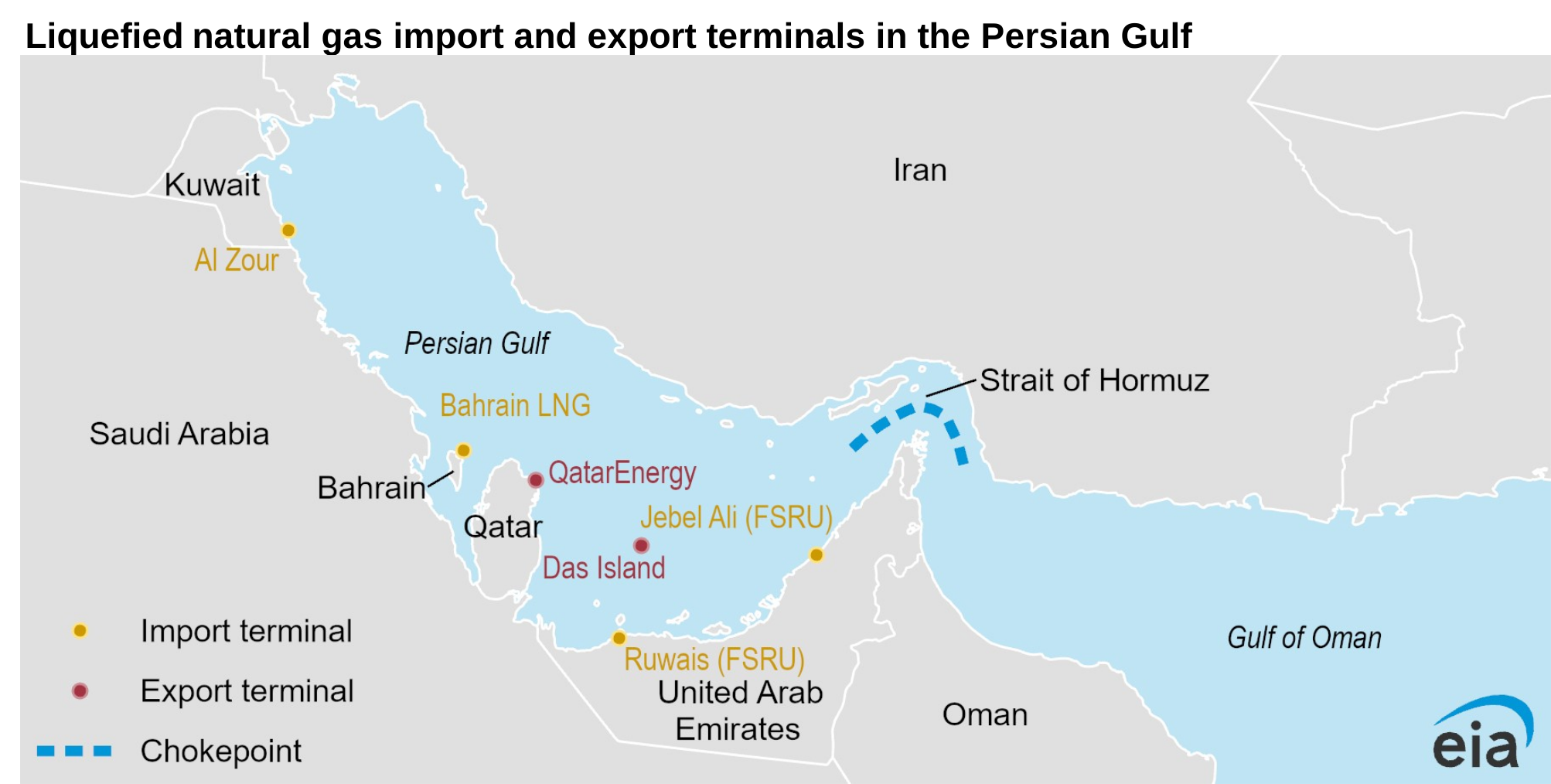
The Gulf dominates global trade in nitrogen fertilizer. Approximate shares moving through Hormuz: ~31 percent of global urea trade, ~18 percent of ammonia trade, ~15 percent of phosphates, ~44% of sulfur trade. Taken together, roughly one-third of global fertilizer trade passes through the strait. This is a BFD. Without nitrogen fertilizers, we can’t feed ~4 billion of the world’s population. Yes. Billion. Not a typo.10
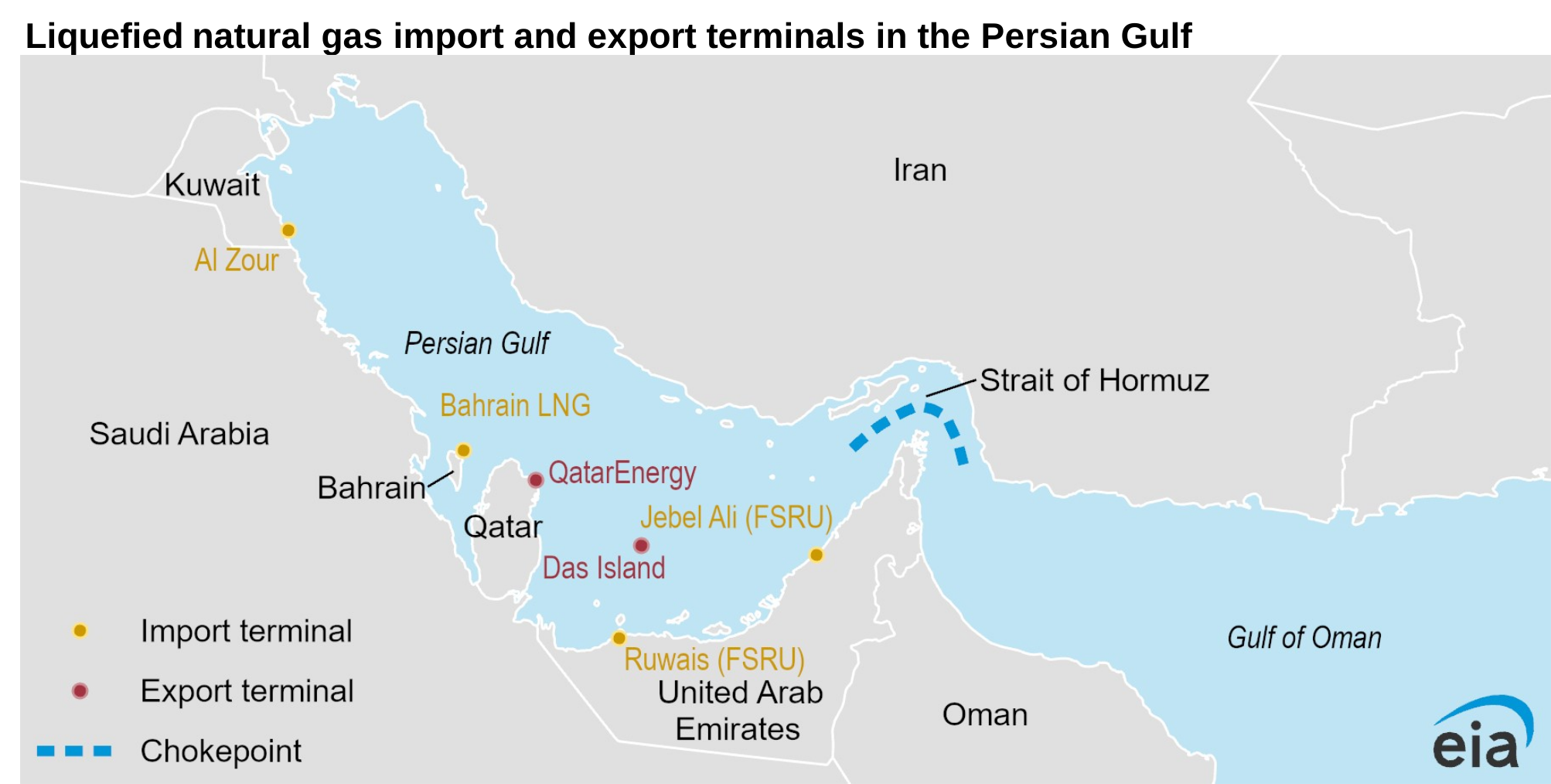
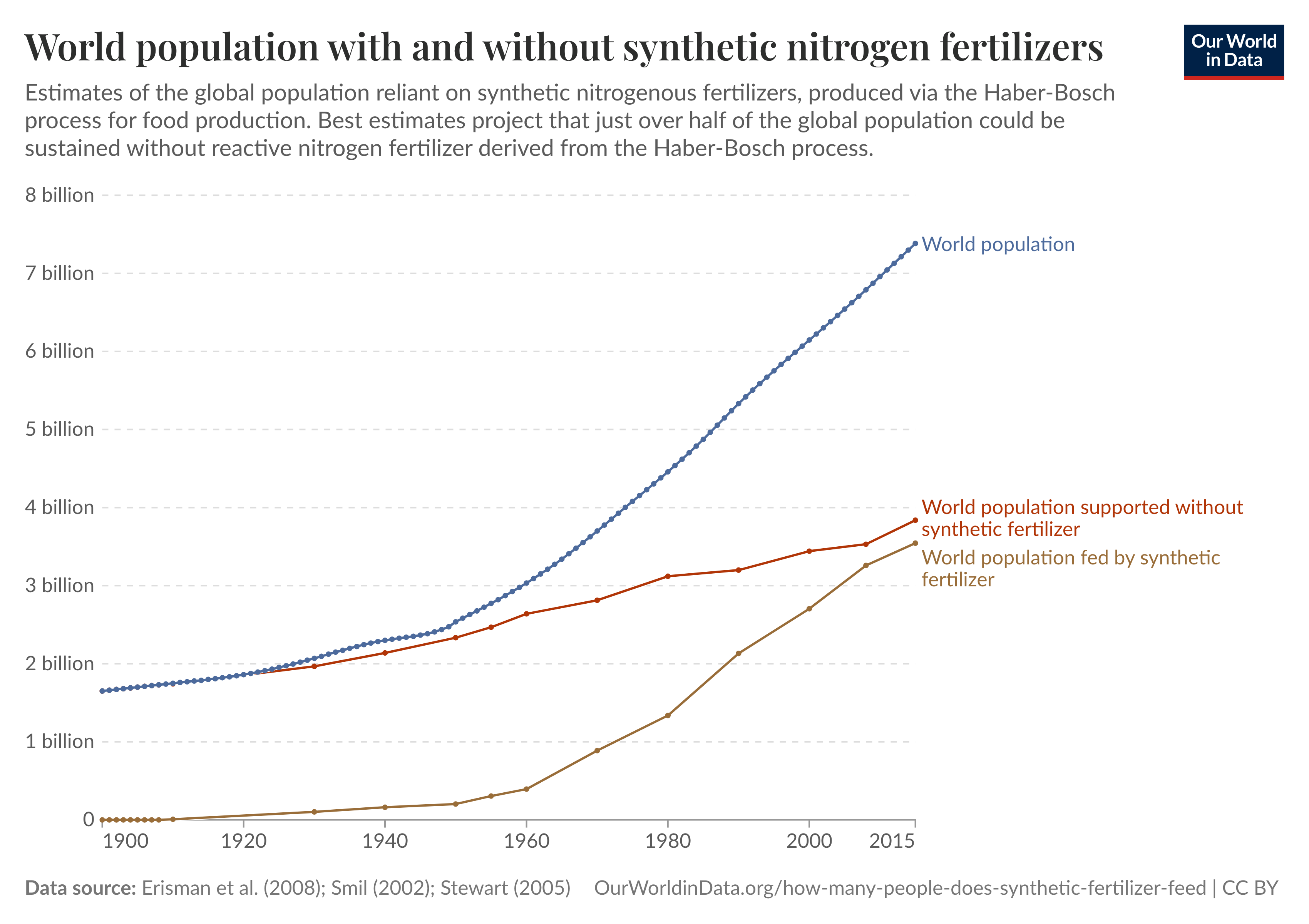
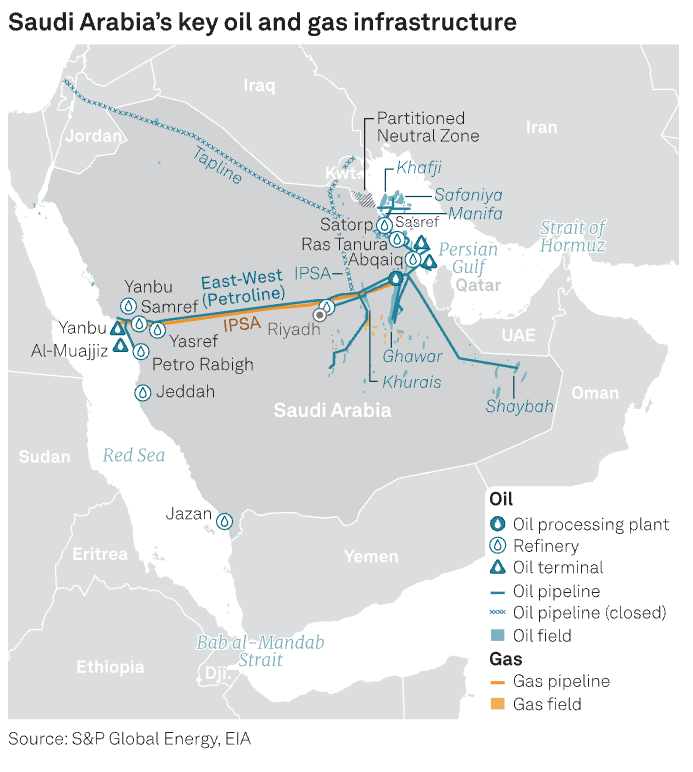
There is no way around the Strait of Hormuz. Markets and tankers seem to be putting their faith in Saudi Arabia’s East-West pipeline, which can theoretically transport ~7 million bpd of Saudi crude to Yanbu on the Red Sea. According to Bloomberg’s Javier Blas, “There are so many VLCCs oil tankers in the Gulf of Aden right now that one could walk from Djibouti to Socrota island without getting their feet wet.” Hope springs eternal, but hope is forgetting about the Houthis, who effectively closed the Bab al-Mandab Strait on October 8, 2023. Heck, even if the Houthis sit this out, or for whatever reason can’t manage to disrupt operations at Yanbu…this is a pipeline we’re talking about. Pipelines can be blown up. Pretty easily. This is not a long-term solution, I’m not even sure it’s a short-term one, especially if Iran and or the Houthis want to get serious here. And considering the new Supreme Leader’s wife and family was assassinated and he (or whoever is using him as a mouthpiece)11 is pledging to keep the Strait of Hormuz closed…seems a decent bet a pipeline is not going to be the world’s savior when it comes to getting Persian Gulf oil.
Am I seriously the only person thinking this:
I asked ChatGPT to help me quantify how much it would cost for the world to no longer depend on oil, natural gas, and fertilizer from the Persian Gulf. After going back and forth, here is what we came up with:
“If the world decided it could no longer rely on the Persian Gulf for energy, the price tag would, conservatively, be ~$4 trillion. Replacing current crude supply from the Gulf elsewhere would require not just drilling more wells, but building an entirely new system around them: pipelines, export terminals, refineries, storage facilities, and additional tanker fleets. Developing large new oil supply typically costs somewhere in the range of $20,000–$40,000 per barrel per day of capacity, which means replacing Gulf exports alone would require $400–800 billion in upstream investment. Once you add the midstream and transport infrastructure needed to move and process that oil, the realistic cost climbs to $1–2 trillion. And even that assumes something very uncertain: impossible: that equivalent reserves actually exist outside the Gulf and can be brought online at scale. So the price is likely much higher, and geologically this may be unfeasible
Replacing Gulf LNG exports would require building new gas fields, liquefaction plants, LNG shipping fleets, and import terminals across the world. With liquefaction terminals costing $10–20 billion each and global replacement capacity likely needing 150–200 mtpa of LNG liquefaction capacity per year, the bill would easily reach $1–1.5 trillion. As for fertilizer: Tthe Gulf is one of the world’s dominant exporters of nitrogen fertilizer precisely because natural gas there is so cheap. Replicating that production elsewhere would require constructing dozens of new ammonia and urea plants along with the gas infrastructure to feed them. At current costs, replacing Gulf fertilizer exports would likely require another $200–500 billion.
This does not factor in time. To do this would take 10-20 years even with a concentrated global effort to wean off of Persian Gulf resources.”
A few additional thoughts here: Weaning off of Persian Gulf oil is most certainly not possible. If the issue were just Iranian crude, it could be done — Iran accounts for roughly ~2 million bpd of production. But if the Strait of Hormuz is closed, that means Iraqi and Saudi and Kuwaiti and UAE oil is also not getting out, and that means upwards of ~15 million (conservatively) bpd is no longer available to the global market. If the world was very aggressive, it could probably come up with an additional 6-9 million bpd from places like Brazil, Canada, Argentina, Guyana, the U.S., and Africa, but that is speculative, and in any case it wouldn’t be the low-cost light crude produced in the Persian Gulf.
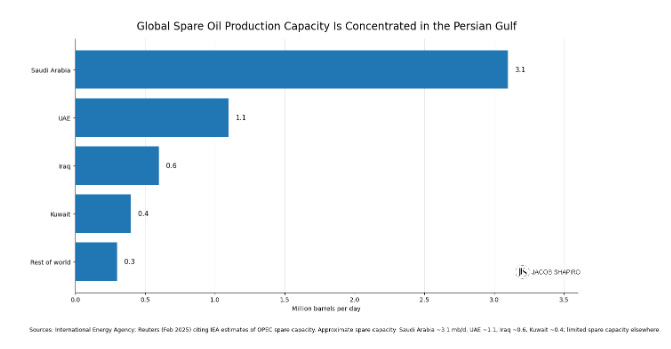
It also doesn’t solve the spare capacity issue, which is what really makes this impossible on any politically relevant horizon. The Middle East is not just supply; it is the marginal barrel. That matters more than raw reserve share. The Persian Gulf’s importance lies not only in how much it produces, but in how much spare capacity and export flexibility it offers. If that remains true, then the world can reduce reliance on Gulf volumes at the margin while still remaining structurally hostage to Gulf stability.
To wit: The IEA says the world’s spare crude production capacity in late 2025 was only a little over 4 million bpd, mostly concentrated in Saudi Arabia, and IEA estimates of OPEC spare capacity at about 5.3 million bpd, with Saudi Arabia, the UAE, Iraq, and Kuwait holding the bulk of it. That means the world’s flexible buffer is still overwhelmingly Persian Gulf-based. Even if non-Middle Eastern producers invest heavily, you are not replacing a Gulf-sized shock quickly, and unless I am wildly overestimating the capacity of the Gulf states to protect pipelines, that means Hormuz will remain critical to global oil flows on any relevant strategic level. Pandora (i.e., closing the Strait of Hormuz) is out of her box, and there’s no putting her back. Significant or long-term closure means very expensive oil and global recession. Intermittent closure and regional instability means we need to re-rate just how cheap that Persian Gulf oil is.
Now, the war may convince wealthier states that dependence on the region must be buffered, priced, and partially redesigned. Asia is most exposed to Persian Gulf oil — about 80 percent of Persian Gulf oil flows through Hormuz go to Asia, which means the region with the strongest structural demand growth remains the most exposed. Europe can diversify more aggressively; the United States barely imports Gulf oil directly; Japan, Korea, India, and especially China have a much harder time. How much are they willing to spend? Irrespective of geography, the economics of withdrawal are brutal. Replacing Gulf dependence means higher delivered energy costs, duplicative infrastructure, and more expensive inventories. Countries may want less dependence in principle, but when prices normalize (probably at a much higher level than what we’ve been accustomed to the last 5 years), political systems will rediscover their love of cheap molecules. This is why I would be cautious about claiming a durable civilizational turn away from the Middle East: we’re talking about selective de-risking, not abandonment.
The picture is not quite the same for natural gas.
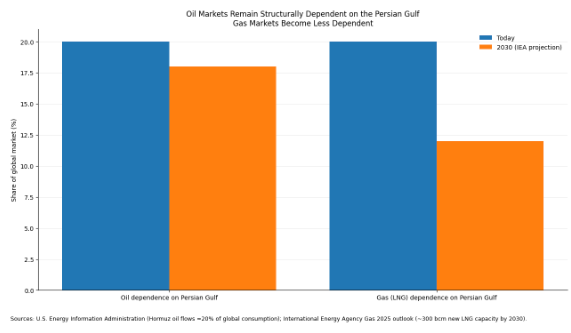
The global natural gas market today is roughly 4.1 trillion cubic meters per year, with supply and demand roughly balanced. But as I’ve been writing about since Russia first invaded Ukraine, there is a huge wave of LNG coming online by 2030. Indeed, the amount of LNG coming online in the next ~4 years is enormous relative to global LNG trade. The IEA’s base case sees global gas demand growing by 380 bcm by 2030. That’s a roughly 1.5 percent annual growth rate, driven largely by electricity demand expansion, industrial use, and replacing coal in Asia. The IEA estimates that there will be ~300 bcm/year of new LNG export capacity over the same time period. “Demand growth under the base case is not sufficient to absorb the coming wave of LNG supply and would result in an imbalance in the global LNG market. Under such conditions, spot LNG prices are likely to come under pressure and could fall towards the short-run marginal cost of US LNG supply, which remains well below current forward price levels.”12 A big chunk of that is to come from Qatar — but not the lion’s share.
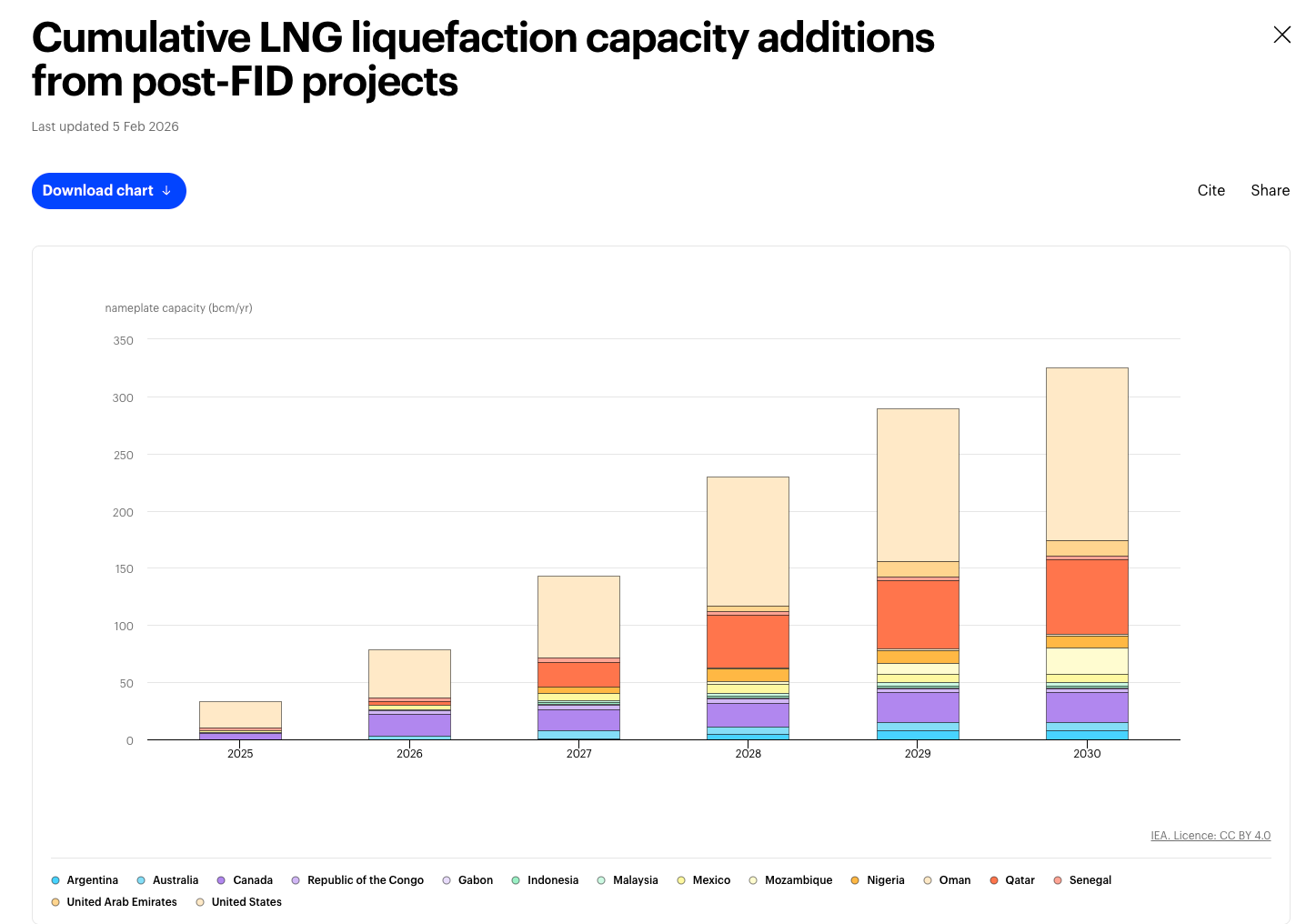
Now, this LNG boom is still relatively modest compared to total gas demand, which is around ~4,150 bcm. LNG made up ~13 percent of global gas demand in 2025, and even with the coming boom in supply will reach ~20 percent of total supply in 2030. But the point is, unlike with oil, switching away from dependence on LNG that has go through the Strait of Hormuz is possible even if unlikely. Unlikely because if you strip out Persian Gulf LNG and look at the impact on prices, you’re looking at a substantial increase in LNG prices for all consumers. U.S. consumers may not feel that they have enjoyed the lowest natural gas prices in the world by a healthy margin since 2022…but they have.
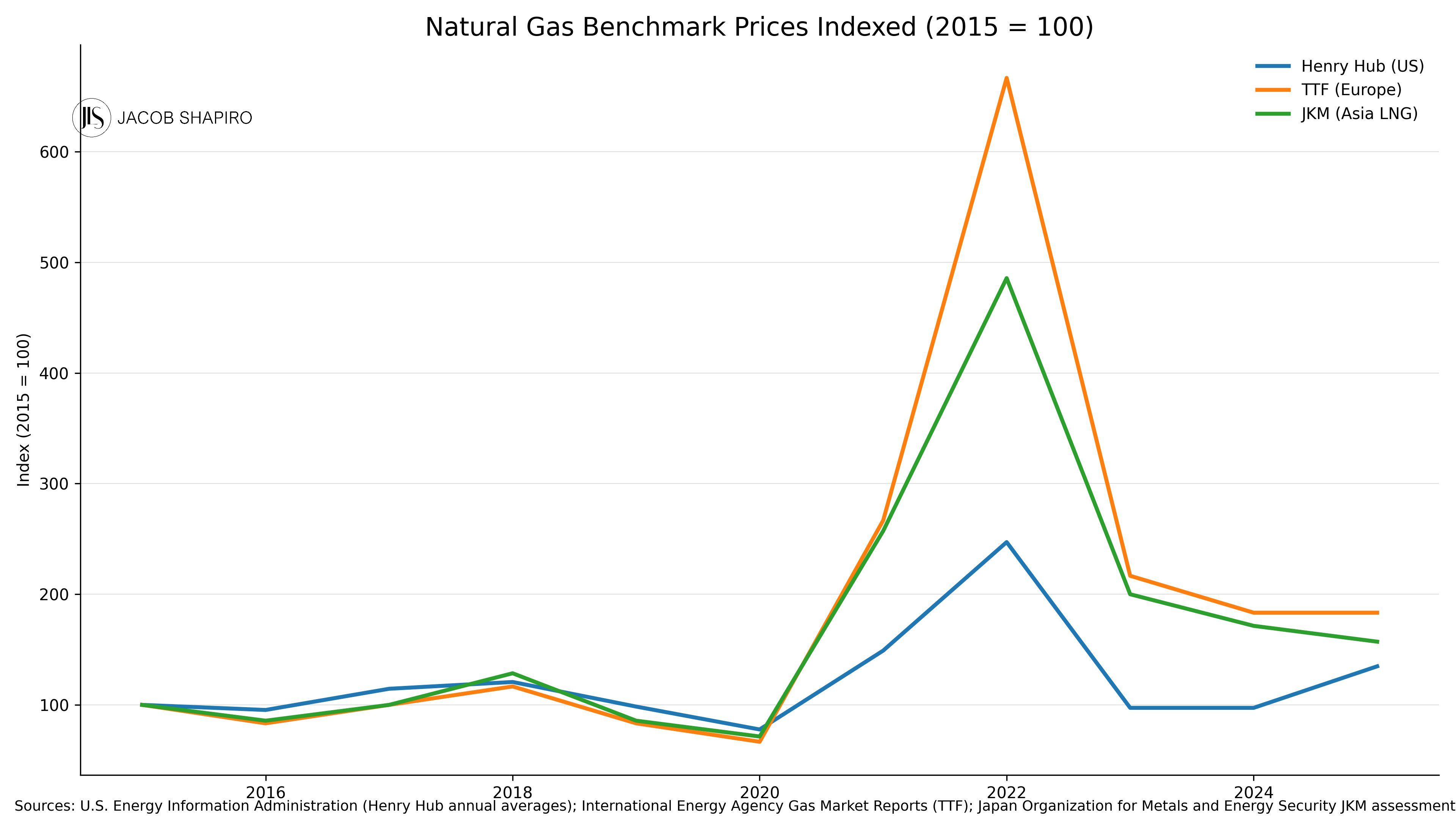
At the same time, however, increased U.S. LNG exports have begun to increase prices for U.S. natural gas. Take Persian Gulf LNG out of the picture along with the amount of new U.S. LNG capacity coming online and you have a situation where U.S. exporters will be able to get more money exporting abroad, which will further raise prices for the U.S. consumer. In previous moments in U.S. history something like this happened, the U.S. simply banned energy exports. (That was actually one of the very first essays I penned here!)13
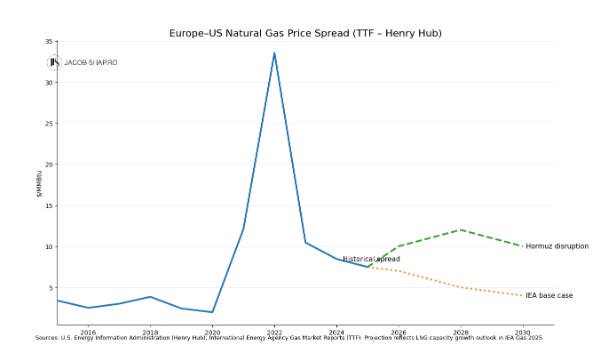
And that raises a deeper question. If the Persian Gulf becomes structurally less reliable, do major gas producers allow their domestic markets to be exposed to global prices indefinitely? The United States is currently the world’s marginal LNG supplier, and its export boom has helped stabilize global markets after the collapse of Russian pipeline gas into Europe. But if prices rise sharply because Gulf LNG disappears from the system, or access to Gulf LNG becomes less reliable, the political pressure to restrict exports would grow quickly. Cheap energy is not just an economic advantage in the United States; it has become a political expectation. #populism #breadandcircuses #gasandufc
In other words, the natural gas market does have an escape valve that oil markets lack. New LNG capacity can be built outside the Gulf. Supply can diversify geographically. Trade routes can shift. But that flexibility comes with its own political risks. The more the world relies on American LNG to stabilize prices, the more American consumers are exposed to global markets, and the more likely Washington is to intervene if those prices spike. So while oil markets remain structurally tied to the Persian Gulf, gas markets are slowly evolving toward something different: a system where dependence on the Gulf can be reduced, but only at the cost of higher prices and new political tensions elsewhere. Oil dependence on the Persian Gulf is a geological fact. Gas dependence on the Persian Gulf is a market structure. The former can’t be changed. The latter is infrastructure.
As for fertilizer: Nitrogen fertilizer is essentially natural gas in another form; wherever gas is cheap, fertilizer can be made cheaply. That means dependence on Persian Gulf fertilizer exports is not nearly as structural as dependence on Persian Gulf oil. Replacing Gulf fertilizer supply might require ~$200–500 billion in new plants, infrastructure, and feedstock. For countries with abundant and inexpensive natural gas, such as the United States…that’s chump change, especially for a commodity so strategic and important. Once geopolitical risk is priced in, it may even start to look like a bargain.
The end of the Gulf
For years, I have risked life and limb14 (see what I did there) by writing how skeptical I am that the Gulf is a place of technological innovation, positive social change, and political stability.15 Aside from the risks to my person and to my bottom line (there is a lot of money to be made saying nice things about the GCC states), for years, I have looked very wrong. (In this, I ironically join the ranks of U.S. officials and analysts going back all the way to the Nixon administration, which gambled that Iran, not Saudi Arabia, was the most stable power in the region and that supporting Iranian regional primacy was in the best interest of the United States because the Shah was a more stable and modern leader than the Saudi King…whoops!)16
Over the past decade the GCC states have become some of the most dynamic destinations for global capital, people, and investment in the world. The United Arab Emirates alone attracted roughly $45.6 billion in foreign direct investment in 2024, a surge of nearly 50 percent year-on-year, placing it among the top ten global FDI destinations. Dubai has become one of the world’s leading hubs for new investment projects, recording over 1,100 greenfield FDI projects in a single year. Saudi Arabia is seeing similar momentum: the kingdom attracted more than $30 billion in foreign investment in 2024 and welcomed around 122 million visitors in 2025, generating roughly $80 billion in tourism spending as it pushes forward with its Vision 2030 economic transformation. The Kingdom is even building movie theaters.17 Toby Keith z”l played a concert there.18 Out with the Wahhabis and their retrograde views on life. Whiskey for my men, beer for my horses.19
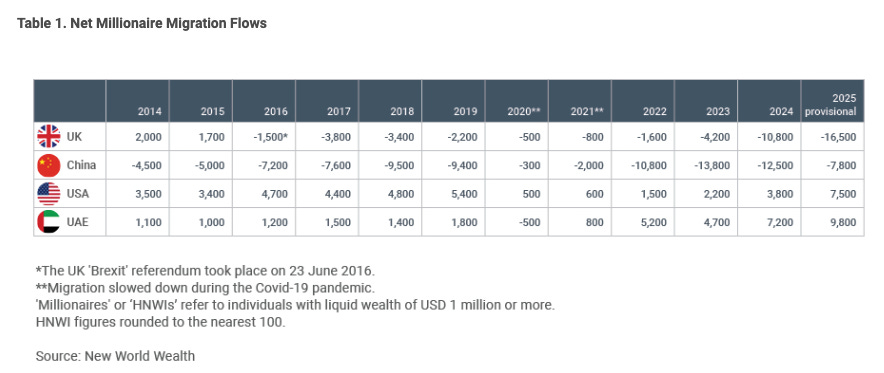
The region is also drawing global wealth at a remarkable pace. The UAE attracted nearly 10,000 new millionaires in 2025,20 one of the largest inflows anywhere in the world. The scale of investment projects underway across the Gulf is staggering. Saudi Arabia’s $500 billion NEOM megacity, massive tourism developments along the Red Sea, and a wave of infrastructure, logistics, and technology investments reflect a broader effort to diversify beyond hydrocarbons. Gulf sovereign wealth funds are among the largest pools of capital on the planet and are expanding their global footprint, channeling hundreds of billions of dollars into technology, infrastructure, and energy projects worldwide. Even in economies still heavily tied to hydrocarbons, diversification is advancing rapidly: in the UAE, non-oil sectors now account for roughly three-quarters of real GDP,21 illustrating how quickly the Gulf is transforming from a purely energy-exporting region into a major node in the global economy.
So much for that. Iran killed it.
Iran didn’t do it alone. Saudi Arabia has already been scaling back its ambitious Vision 2030 goals. The NEOM megacity was originally conceived as a 170-kilometer linear city housing millions of people, but recent reports suggest that only a few kilometers may be completed by 2030. Foreign investment inflows have also fallen short of Vision 2030’s targets, with annual FDI still far below the $100 billion level the kingdom hopes to reach. As for the UAE: a country that wants to become a modern-day safe haven for the world’s wealthiest looking for a stable place to park their capital and lives does not have the luxury of aggressive foreign policy adventurism, and yet the UAE is supporting the RSF in Sudan and the Abiy government in Ethiopia, responsible for some of the worst humanitarian catastrophes of this decade, and also finds itself on the other side of Saudi Arabia, Egypt, and other Arab allies in its geopolitical choices. In addition, Iran has fired more rockets and drones at the UAE than Israel. Read that sentence again and then tell me the UAE is a good place to park one’s wealth or future.
Even if the UAE and Saudi Arabia and Qatar and Kuwait and all these places make good on the socioeconomic transformations they are attempting…they are neighbors to a region that has been a constant source of geopolitical instability for centuries. Centuries! They can execute their plans perfectly and yet they are still caught between Turkey, Iran, and Israel, at the fault-line between Sunni and Shia Islam, astride territory that just 10 years ago was under existential threat from a medieval-style fundamentalist Caliphate that was chopping peoples heads off until the U.S., Russia, and Iran joined together to stop them (talking about ISIS here if you are missing the reference). And that’s before we even get to the viability of the transformation these countries are attempting, the palace intrigue, the resource dependency, etc.
The world won’t leave the Middle East because it can’t. Not because of LNG of fertilizer, but because of oil. Because of Saudis in Audis.22 That is what this all comes back to. That leverage will give the Saudis and the GCC states leverage at a global level, and will ensure wealth for generations to come. But that does not mean these societies are going to become uniformly wealthy, liberal, and innovative. It does not change the simple fact of geography that they are next to some of the most unstable geopolitical forces in the world. I’ve joked in the past that Dubai is like the cantina scene in Star Wars: A New Hope — everyone is there. In the past I’ve meant it as a compliment. But the truth is it is actually an indictment. If you’re in that cantina, you’re stuck on Tatooine because you’re a smuggler or a criminal or an arms dealer or a Jedi on the run. You don’t go to Mos Eisley if you have choices. You go to Mos Eisley because you don’t have choices.
If someone in Nayib Buykele’s government reads this and realizes, “Oh frack, this war is a UAE-sized opportunity to become a global safe haven,” just remember where you got the idea, k?
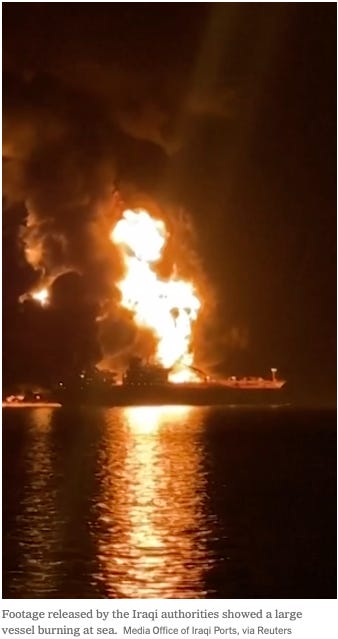
The future of the Gulf as a center of global commerce — that was a capital-induced mirage from a unipolar world. The mirage is gone, the reality now burning in the light of the tankers on-fire in the Gulf. This was, is, and for our lifetimes will be a resource extraction story. This is Arrakis except the Kwisatz Haderach isn’t coming. The B-52s (and the Charles de Gaulle and even the fracking Pakistani Navy23) are coming to make sure they can get their product out. Allow the product out efficiently and your elites get wealthy and you get to feel self-important. You’ll even get U.S. presidents kissing your butt. But it’s all about the oil. That’s all that matters. Try to keep the wealth for your millennia-old civilizational state and you get Iran. FAFO. The Chuck Norris Premium. Etc.
Iran understands that this is the leverage it has, and the only leverage it has ever had. The only chance for the Iranian regime to survive is use that leverage. This is existential now for the Iranian regime, and now that the taboo of blocking the Strait is broken, it will become more frequent. Think about the last 100 years of Iranian history: Mossadegh wanted to nationalize Iranian oil. The U.S. helped get rid of him and backed the Shah, who fell within 30 years in favor of a regime predicated on thuggish theocracy and Iranian nationalism. Even if the Supreme Leader falls and the Iranian people rise up and elect a liberal-style rule — everything about Iranian geopolitics suggests that, just like Mossadegh, that ruler will attempt to assert Iranian primacy in the Persian Gulf at the expense of the U.S.-backed Arab allies and without caring much at all about what the U.S. thinks about the role of a “proper” Iranian leader.
The U.S. is severely underestimating Iran and the amount of punishment it can take. Because the Iranian people, though they likely do not have love for their regime anymore (and haven’t for decades), have even more vitriol for foreign imperialists stealing their resources and killing them. The Iranian people supported Mossadegh in 1951 even though the decision to nationalize Anglo-Iranian was destroying the Iranian economy because it was more important to be self-determined than to be colonized. Since this conflict has started, the Iranian people have been threatened with loss of territory, with foreign actors inciting civil war along ethnic lines, with acid rain in their cities because Israeli is bombing oil depots, with bombings of girls’ schools and other horrific incidents. They will rally around the flag of their leaders and settle up their domestic accounts later.
So unless you think Iran will emerge from all this as a liberal democracy willing to sign the Abraham Accords and open up to Western investment and accept a role as a subordinate in a region Persia has viewed as its sphere of influence since the time of Cyrus the Great…I think you have to question the viability of the GCC states to live up to the incredibly ambitious dreams they have articulated.
Trump is in trouble
Trump is now trapped in the same economic vortex that killed the Biden administration: Insisting the economy is great and never better (“roaring” is the phrase he most recently used) even as Americans a) disagree, b) oppose the war, and c) are about to see a sizable spike in inflation due to the closure of the Strait of Hormuz. Even if shipping in the Strait returned to normal tomorrow (a practical impossibility), we are looking at months of higher energy and food prices. Trump may well be right that he could shoot someone on 5th avenue and walk scot free. But his political life will not survive presiding over a massive economic crisis, and unless he wraps up the war by the end of the week, I think that crisis is coming. And it might be coming even if the war is over by Sunday.
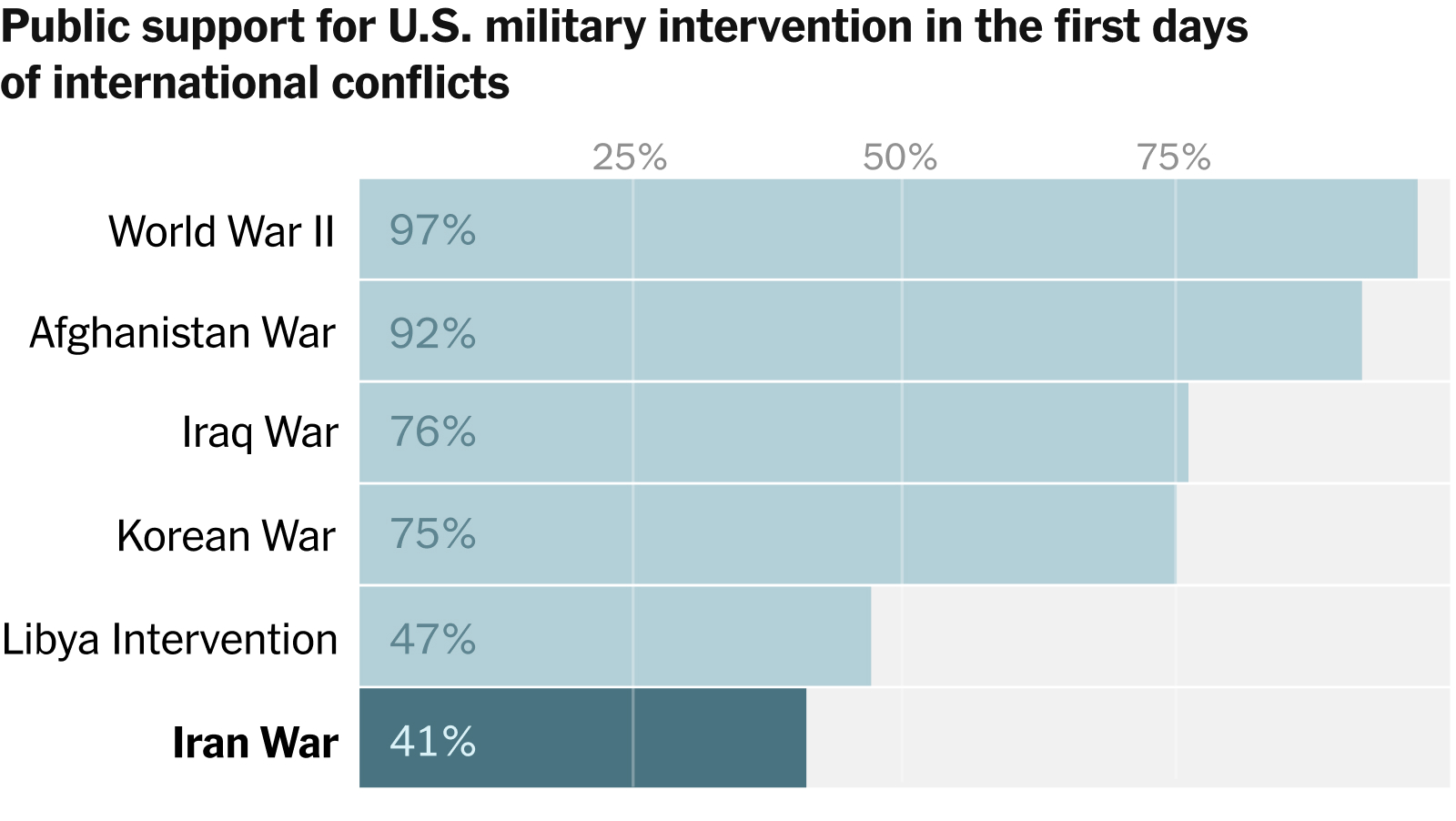
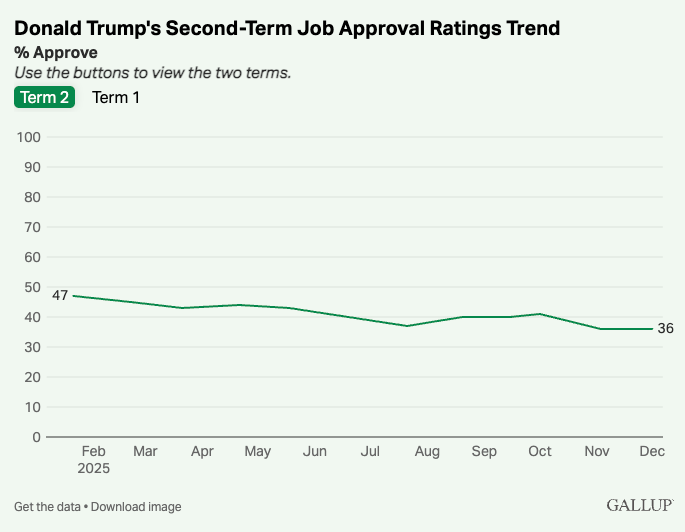
The mid-terms? They are already lost. The Republicans will lose the House, which means the Democrats will probably impeach Trump and will certainly block Trump from doing anything he wants. The Senate is probably also lost too. But those aren’t the questions that should be bothering Trump. How high does inflation have to go before enough Republican Senators are willing to cross the aisle and vote to get rid of President Trump if articles of impeachment are brought? President Trump’s war is illegal. (It’s a war, and only Congress can declare war.) His tariffs? Illegal. There’s more than enough evidence of corruption for Congress to go after him if politics makes it safe to do so (and that is what this is all really about, not whether Trump is or isn’t guilty, but how safe he is politically).
It’s admittedly a low-probability scenario…but start thinking about what a J.D. Vance lameduck presidency looks like. Does Trump’s misstep in the Middle East open the door to a leftist AOC-style populist victory down the road? Does it clear the deck and open the possibility of a true moderate (in either party) to cut through the affective polarization of the last decade+? If I am right about the impact that is coming for the economy, U.S. politics is downstream and will be hugely affected.
Türkiye and Israel
Former Israeli Prime Minister Naftali Bennett said this last month: “A new Turkish threat is emerging. I want to be very clear: Turkey and Qatar have gained influence in Syria, are seeking influence elsewhere and everywhere throughout the region, and from here I warn: Türkiye is the new Iran. Erdogan is sophisticated, dangerous, and he seeks to encircle Israel. And while some senior Israeli officials were on Qatar’s payroll, Qatar and Turkey are nourishing the Islamic Brotherhood monster that is growing and eventually might become as dangerous as the one created by Iran.”24
Current Israeli Prime Minister Benjamin Netanyahu has made a political career out of fear mongering. (One could have said this about Churchill in the early 1930s, but the difference is Churchill was right, Nazi Germany almost took over the world. Iran couldn’t even defend its airspace for more than 48 hours.) Former Prime Minister Bennett is copying his old mentor’s playbook and identifying Türkiye as an existential threat. A charitable interpretation of Bennett’s comments would be he believes what he is saying. And there is no doubt that Türkiye — far more so than Iran — poses a potentially significant and unique threat to Israel. But the less charitable interpretation is that Bennett wants to be PM again and thinks gining up the next Iran will get him there eventually. One wonders what the cost of the boogeyman will be.
Israel has shown incredible military and intelligence acumen since the horrific intelligence failure that led to October 7th — I, for one, did not think Israel could so thoroughly destroy Hamas, Hezbollah, and now Iran’s capabilities, and with very little negative consequence for Israel itself. Moreover, the Israeli electorate is still sorting through the collective PTSD incurred during the October 7th attacks, which makes a permanent war footing seem necessary. Israel also possesses nuclear weapons. So even if Israel’s conventional forces failed, if faced with an existential threat from a conventional power, Israel would have what Iran does not have today — a nuclear deterrent.
This is also what makes Israel’s future hard to predict. Jewish polities in present-day Israel never lasted long because they were consumed by their own dissension. The seeds of that internal disorder are apparent even today. Israel is a highly divided society. This isn’t the time and place for a deep dive on Israeli demographics, you can go read my 5,000 word missive from 2017 on that if you wish.25 But suffice to say the ultra-religious are growing, the Arab population is growing, and the secular middle that made Israel into what it is today is shrinking every year. But nuclear weapons changes the game — the Romans and the Persians and the Babylonians and the Assyrians conquered present-day Israel because previous Jewish polities couldn’t put up a unified fight or front. Today, even if Israel’s politics hamstring its capabilities (which judging on recent performance is a long way’s off)…it still has nuclear weapons.
All of which is to say: Israel may pose more of a threat to Türkiye today than vice versa. If you are Erdogan and you are hearing Bennett’s comments, what is the first thing that comes to mind? Perhaps you worry about yourself, or about making sure AKP members don’t get pagers, or about new Kurdish insurgencies. Ironically, by destroying Iran for a generation, Israel and the U.S. have done Türkiye a great favor. Iran is the natural balancing power to Türkiye in the Middle East. Iran cannot balance against Türkiye now, leaving a vacuum that only Türkiye can fill. Türkiye is a modern industrial power, with a much more powerful military than Iran. Its greatest challenge in the region is now Israel. What does Türkiye do next? Build up Syria as a proxy of its own? Achieve its own nuclear deterrent? Attempt to capture the GCC states and other Sunni Arab states into a grand Sunni coalition with Ankara at the head?
The world cares about the Strait of Hormuz for all the aforementioned reasons. But ironically the future of the region may have much more to do with what happens in the Mediterranean than in the Strait.
A question
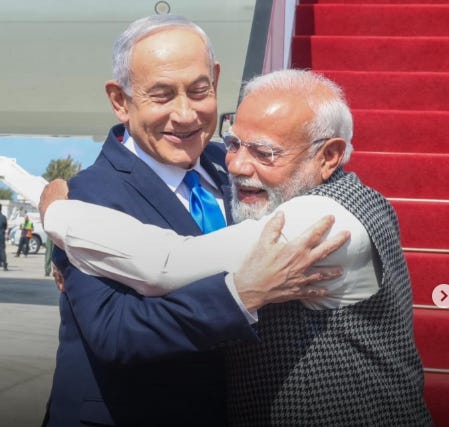
Roughly a week before Israel and the U.S. began bombing Iran, Indian Prime Minister Narendra Modi made a two-day state visit to Israel, deepening what both governments now describe as a “special strategic partnership.” Modi addressed Israel’s parliament, pledged that India stands with Israel “with full conviction,” and announced plans to expand defense cooperation, technology partnerships, and negotiations toward a free-trade agreement.
Roughly half of India’s crude imports come through the Strait of Hormuz last year.
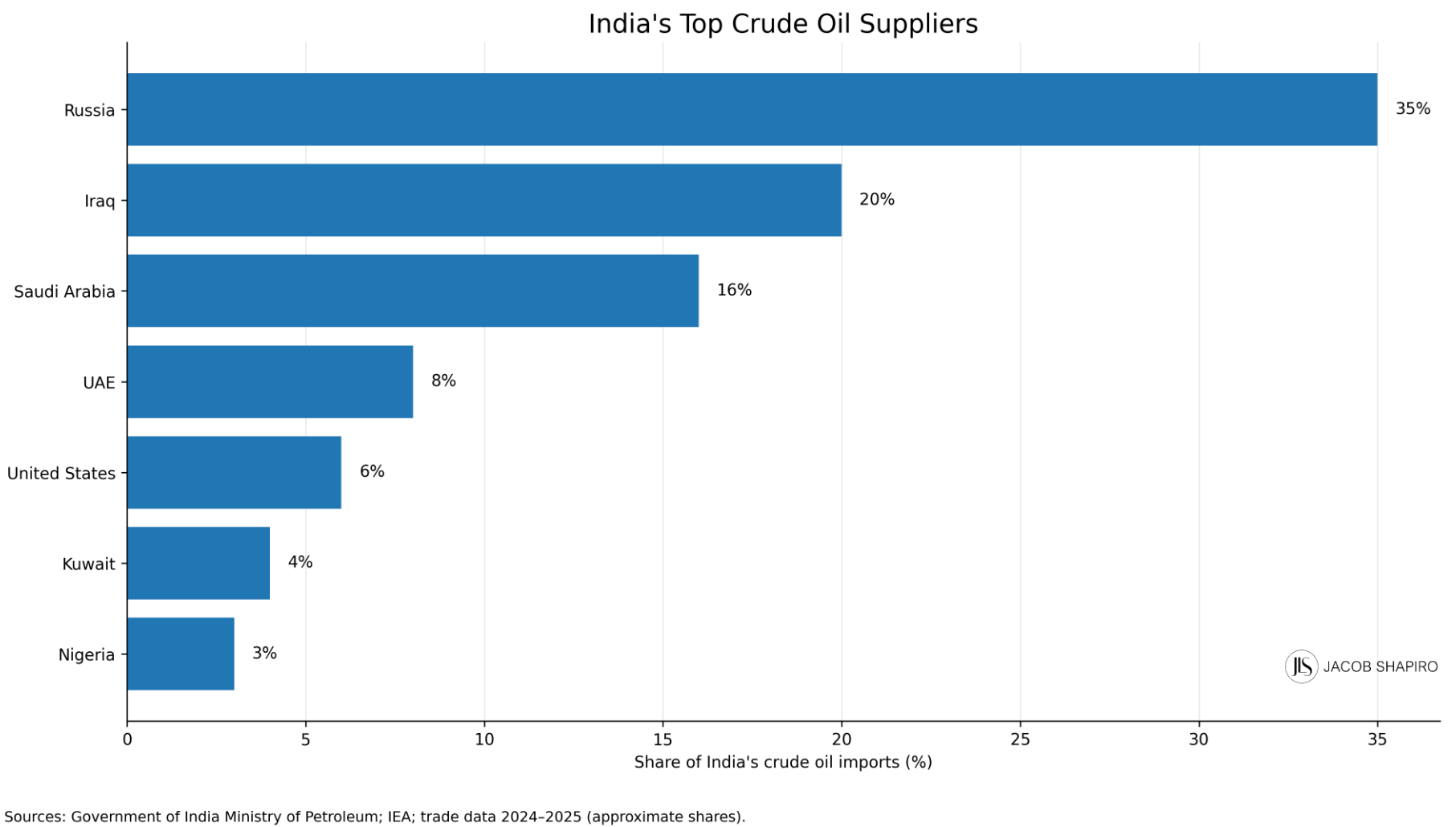
What did Modi know? When did he know it? What does this mean for India’s relations with Israel? With the Gulf states? With the Muslim world? The media has been awash with silly speculation about how for the U.S. this is all about China, or about how China will take the opportunity to go after Taiwan. That’s all nonsense, China’s position in all this is clear and predictable. What this means for India’s geopolitics is much less clear to me, and a place to focus future attention.
אַ מענטש טראַכט און גאָט לאַכט
https://www.axios.com/2026/02/18/marco-rubio-cuba-secret-talks
https://www.iranintl.com/en/202601255198
https://www.iranintl.com/en/202602275526?utm_source=chatgpt.com
The Prize, Nixon, Kissinger, and the Shah, Energy and Civilization
https://www.eia.gov/todayinenergy/detail.php?id=65504&utm_source=chatgpt.com
https://www.eia.gov/todayinenergy/detail.php?id=65584&utm_source=chatgpt.com
https://ourworldindata.org/how-many-people-does-synthetic-fertilizer-feed
https://www.npr.org/2026/03/12/nx-s1-5745689/iran-war-israel-us
https://iea.blob.core.windows.net/assets/db3d568d-b985-4cc2-bb1a-119517f118ac/Gas2025.pdf
https://en.wikipedia.org/wiki/Jamal_Khashoggi
https://geopoliticalfutures.com/no-exit-us-saudi-relationship/
https://www.amazon.com/Nixon-Kissinger-Shah-United-States/dp/0199375690
https://variety.com/2019/film/news/saudi-arabia-movie-theaters-invest-35-billion-dollars-1203180529/
https://www.npr.org/sections/therecord/2017/05/22/529500923/how-did-toby-keith-get-to-do-a-concert-in-saudi-arabia
https://www.henleyglobal.com/publications/henley-private-wealth-migration-report-2025/great-wealth-flight-millionaires-relocate-record-numbers
https://www.financemiddleeast.com/economy/uae-gdp-hits-dh1-78-trillion-in-2024-non-oil-economy-accounts-for-75/?utm_source=chatgpt.com
https://www.nytimes.com/2026/03/10/world/middleeast/pakistan-gulf-conflict-oil-economy.html
https://geopoliticalfutures.com/demographics-and-the-israeli-palestinian-conflict/
Be careful which OSint you follow. Lots of propaganda out there.
azizi discussion